.png)


Last Updated on February 09, 2026
Last Updated on February 09, 2026




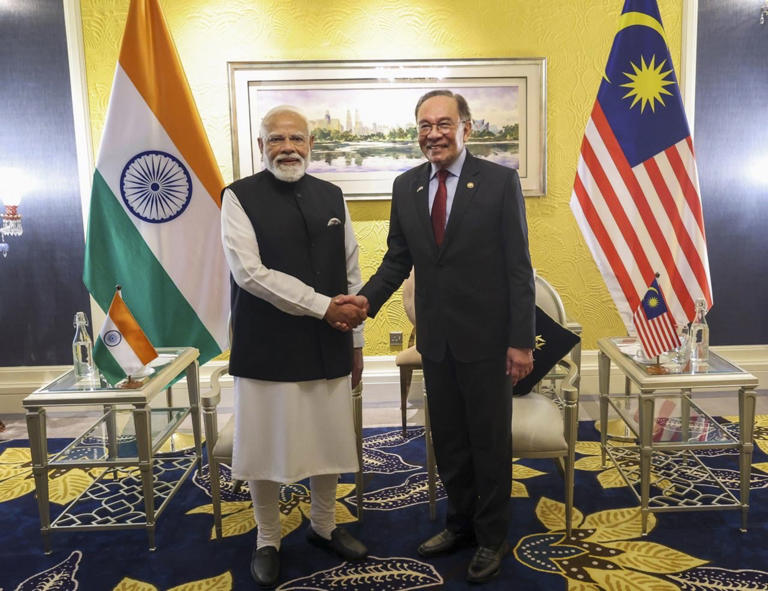
Malaysia joined India in strongly condemning cross-border terrorism, signalling a greater understanding of India’s position on that issue, as PM Narendra Modi said after a bilateral meeting with counterpart Anwar Ibrahim that the message from both countries on terrorism was clear: no double standards, no compromise.
Modi’s visit to Malaysia saw close to a dozen agreements and announcements for cooperation in areas spanning across defence and security, semiconductors, social security for Indian workers, UN peace keeping, disaster management and countering corruption.
While similar joint statements issued after summit meetings in 2015, 2017 and 2024 had condemned terrorism in all its forms and manifestations, on this occasion it also specifically mentioned cross-border terrorism, an expression that helps India flag Pakistan-sponsored terrorism. The latest leaders’ joint statement also reaffirmed commitment to strengthen bilateral and multilateral cooperation in countering terrorism, including in the UN and FATF, radicalisation and violent extremism.
“In the field of security, we will strengthen cooperation in counter-terrorism, intelligence sharing, and maritime security. We will also further expand defence cooperation,” said Modi, thanking Ibrahim for his strong condemnation of the Pahalgam attack and the Red Fort blast. The PM underlined the significance of growing friendship between the 2 countries in the current climate of global uncertainty, saying the leaders backed all peace efforts and agreed that reform of global institutions was essential to address today’s challenges.
While there was no official word from either side about whether the extradition sought by India of fugitive Zakir Naik was discussed in the meeting, official sources said India remains in touch with Malaysia to address legal issues related to its extradition request.
Modi and Ibrahim also participated in a CEO Forum that, Modi said, opened new avenues for trade and investment. “Alongside AI and digital technologies, we will advance our partnership in semiconductors, health, and food security. Guided by strategic trust, we will chart a pathway towards economic transformation,” said PM Modi.
According to the joint statement, the leaders expressed satisfaction over the robust defence relationship between Malaysia and India, underscored by “the regular exchanges, visits, staff talks, exercises, training courses and defence industry collaboration”. While there was no mention of it in the statement, India is considering sale of Dornier aircraft to Malaysia and also supply of naval platforms by Indian shipyards. “The Prime Ministers encouraged the growing maritime cooperation between India and Malaysia, including through regular goodwill and operational deployments,” said the joint statement.
There was focus on cooperation in the Indo-Pacific with Modi saying India will further broaden its engagement with the southeast Asia grouping and added the leaders agreed to an early completion of the ASEAN–India Trade in Goods Agreement (AITIGA) review.
“The Indo-Pacific region is emerging as the engine of global growth. We are committed, together with ASEAN, to promote development, peace, and stability across the Indo-Pacific. India places high priority on ASEAN centrality,” said Modi.
Modi and Ibrahim, amidst continued tensions in South China Sea over Chinese activities, reiterated their commitment to respecting freedom of navigation and overflight, and unimpeded lawful commerce, based on the principles of international law. “The two Leaders urged all parties to resolve disputes through peaceful means in accordance with the universally recognised principles of international law, including UNCLOS 1982,” said the joint statement.
The leaders also agreed to strengthen cooperation in multilateral forums, including United Nations, and support reforms of international institutions. “They pledged to work together to enhance multilateralism, reflective of contemporary realities so as to make international organisations, including the UNSC, more representative,” said the joint statement, adding Modi deeply appreciated Malaysia’s support for India’s permanent membership in a reformed UNSC. Ibrahim backed India’s 2026 BRICS chairmanship and India’s Malaysia’s role as a BRICS Partner Country, while taking note of Malaysia’s aspiration to become a member of BRICS.
Ahead of the elections in Tamil Nadu, Modi also reached out to the Tamil community in Malaysia as he said both countries were connected by a shared affection for the Tamil language and that the strong and vibrant presence of Tamil was visible in education, media, and cultural life in the country. The PM said that an audio-visual agreement signed during his visit will bring “our hearts even closer through films and music, especially Tamil cinema”. Amongst the key announcements during Modi’s visit was establishment of a dedicated Thiruvalluvar Centre in Universiti Malaya, Kuala Lumpur and also institution of Thiruvalluvar Scholarships for Malaysian Nationals.
For clarifications/queries, please contact Public Talk of India at:
+91-98119 03979 publictalkofindia@gmail.com
For clarifications/queries,
please contact Public Talk of India at: