.png)


Last Updated on January 31, 2026
Last Updated on January 31, 2026





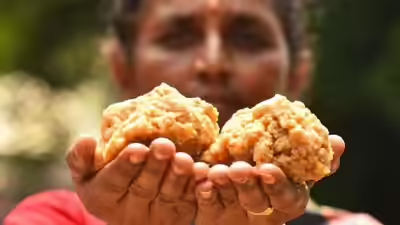
HYDERABAD: The special investigation team of the CBI, in its chargesheet filed in Nellore ACB court, has not made any reference to the ghee supplied to the Tirumala Tirupati Devasthanams (TTD) as being adulterated with animal fats.
It, however, said the laboratory tests of the ghee samples revealed that synthetic ghee was supplied for making laddu prasadam. It was not cow ghee at all, but ghee made from synthetic material blended with vegetable oils, it said.
Immediately after coming to power, TDP supremo and chief minister N Chandrababu Naidu had in Sept 2024 alleged that ghee adulterated with animal fats had been used to make the laddu prasadam during the previous YSRC govt’s tenure (2019 to 2024). The SIT was formed to investigate the allegations that ghee mixed with tallow and lard was supplied to TTD.
The CBI investigation found that the samples drawn from tankers supplied by AR Dairy in July 2024 were not cow ghee samples, but samples of synthetic ghee.
It also described the ghee supplied by Bhole Baba dairy and its proxies as “fake ghee”.
The TDP, following Naidu’s allegation, had released a copy of the lab report from the National Dairy Development Board’s Centre for Analysis & Learning in Livestock & Food (NDDB-CALF) that made reference, though with conditions, that the samples were adulterated with animal fats.
According to the chargesheet, the CBI asked NDDB to carry out a fresh round of raw data analysis and further testing of the remaining ghee samples drawn by TTD from four tankers of AR Dairy (on July 6 and 12, 2024) to obtain a conclusive opinion on adulterants used by the dairy.
NDDB conducted the tests and submitted its report on March 27 last year. The chargesheet contains the key findings of the latest lab report. It states the presence of butyric acid was below the limit of quantification in all four samples, suggesting that the content of milk fat was very low.
It also noted that the presence of lauric acid and myristic acid despite very low milk fat content, suggested that there was a presence of coconut oil and/or palm kernel oil. Fatty acid analysis showed the use of palm oil and/or palm stearin. It also said chances of the presence of fish oil in the ghee samples appeared very rare.
The lab report, as presented in the chargesheet, showed that the milk fat was fake. In two samples there was no cholesterol, concluding that they were made of vegetable oils. The report further stated that the absence of cholesterol suggested that chances of the presence of tallow, lard, and fish oil were “very low”.
Based on the fatty acid profile and presence of beta sitosterol in ghee samples, it was concluded that these samples were primarily a mixture of palm oil and/or palm stearin with palm kernel oil, the chargesheet stated.
For clarifications/queries, please contact Public Talk of India at:
+91-98119 03979 publictalkofindia@gmail.com
For clarifications/queries,
please contact Public Talk of India at: