.png)


Last Updated on March 03, 2026
Last Updated on March 03, 2026




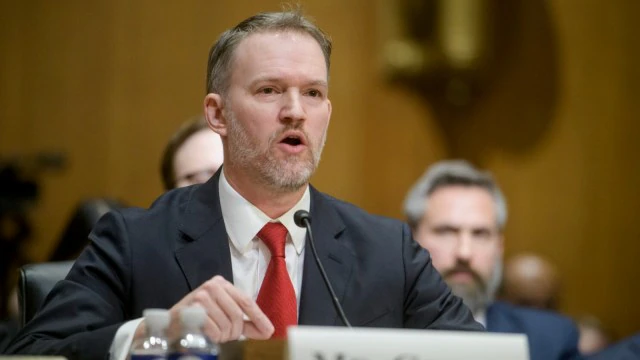
As US negotiators began their two-day trade talks in New Delhi on Wednesday, United States Trade Representative (USTR) Jamieson Greer said in Washington DC that the US has received the “best ever” offer from India. Citing New Delhi’s resistance to importing American agricultural products, he also said India has been a “difficult nut to crack”.
“I have a team over there right now, as we speak, in New Delhi. There’s resistance in India to certain row crops and other meats and products. Like you said, they’re very difficult nut to crack. I agree with that 100 per cent, but they’ve been quite forward leaning…the type of offers they’ve been talking to us about have been the best we’ve ever received, as a country. I think that (India) is a viable alternative market,” Greer said responding to a question before the US Senate Appropriations Committee.
While the US has been pushing for diversification of its agricultural exports, particularly row crops like corn and soybeans, away from China, India has remained firm on protecting India’s small farmers from foreign competition. Differences over the agriculture trade had resulted in the breakdown of trade talks between the two countries in August earlier this year.
Earlier, on Monday, US President Donald Trump threatened fresh tariffs on Indian rice over concerns of dumping in the US market. Washington has already imposed 50 per cent tariffs on New Delhi, the highest on any country globally. Trump’s comments came after a Louisiana-based US farmer representative, in a White House-hosted roundtable, said they are struggling due to the dumping of rice in the US by countries such as India, China, and Thailand, where Trump subsequently responded by saying countries should not be dumping rice in the US and that tariffs will solve the problem.
Picking just India among the three countries named by the farmer representative, Trump asked US Secretary of the Treasury Scott Bessent: “Why is India allowed to do that? They have to pay tariffs. Do they have an exemption on rice?” When Bessent said the US is still working on a trade deal with India, Trump reiterated, “but they [India] shouldn’t be doing that..I have heard this from others”. “We will get it settled. Tariffs solve the problem in two minutes…,” Trump said.
Prime Minister Narendra Modi, during his Independence Day speech, had reiterated India will not compromise on the well-being of its farmers, fisherfolk, and cattle keepers, amid a standoff in trade negotiations with the US over access for American products in India’s agriculture and dairy market.
The US annually exports soybeans worth $30 billion, maize $17.2 billion, wheat $7.3 billion and rice $1.9 billion, and largely to China, Mexico, the EU, and Japan, as per the Indian Council for Research on International Economic Relations (ICRIER).
Greer said several other countries could use US soybeans for biofuels. With India’s resistance to genetically modified (GM) products, there are indications New Delhi could consider the use of imported soybean for biofuel as a breakthrough for a trade deal. To contain domestic inflation, the US had in November dropped reciprocal tariffs on several agricultural products, including coffee and tea, tropical fruits and fruit juices, cocoa and spices, bananas, oranges, and tomatoes, beef, and additional fertilisers.
According to a USTR report released earlier this year, the US had raised concerns over India’s agricultural support programmes, regulations over genetically modified (GM) products and restrictions on dairy products.
“India requires that dairy products intended for food be derived from animals that have not consumed feed containing internal organs, blood meal, or tissues of ruminant or porcine (pig-related) origin, and that exporting countries certify these conditions, which lack a discernible animal or human health justification,” the report said.
In its report in February, think tank ICRIER said India is the world’s largest dairy producer, its market is largely dominated by domestic cooperative and private companies, with limited global brands. And that allowing US dairy firms entry could enhance competition, potentially improving product variety and quality for Indian consumers.
“However, Indian authorities argue that these trade barriers align with the country’s food safety and cultural norms. Furthermore, India has consistently maintained a cautious stance on foreign dairy imports to safeguard the interests of its dairy farmers, most of whom operate in small-scale, cooperative-based systems,” ICRIER said.
The think tank also argued India cannot insulate itself indefinitely with tariffs and to achieve growth, India must transition towards a competitive, high-value agricultural export strategy through phased tariff reduction, agri- R&D investment for productivity improvement, and value chain modernisation.
For clarifications/queries, please contact Public Talk of India at:
+91-98119 03979 publictalkofindia@gmail.com
For clarifications/queries,
please contact Public Talk of India at: