.png)


Last Updated on December 22, 2025
Last Updated on December 22, 2025





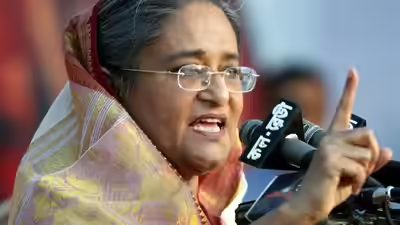
Former Bangladesh prime minister Sheikh Hasina reacted to the death of student leader Sharif Usman Hadi, accusing the Muhammad Yunus-led interim government of presiding over “lawlessness” and claiming the violence reflects a breakdown of governance that has worsened since her ouster.
In an email interview with ANI, Hasina said the killing of the youth leader underscored a growing culture of violence under the interim administration, warning that the situation was destabilising Bangladesh internally and straining ties with neighbouring countries, particularly India.
“This tragic killing reflects the lawlessness that uprooted my government and has multiplied under Yunus. Violence has become the norm while the interim government either denies it or is powerless to stop it. Such incidents destabilise Bangladesh internally but also our relationships with neighbours who are watching with justified alarm. India sees the chaos, the persecution of minorities, and the erosion of everything we built together. When you cannot maintain basic order within your borders, your credibility on the international stage collapses. This is the reality of Yunuss Bangladesh,” Hasina said.
Her remarks came after the death of Sharif Osman Hadi, a prominent youth leader associated with Bangladesh’s 2024 “July uprising” and spokesperson of the political platform Inqilab Mancho.
Hadi was shot at close range by unidentified assailants while travelling in a rickshaw in Dhaka’s Bijoynagar area on December 12. He sustained a critical gunshot injury to the head and was initially treated at Dhaka Medical College Hospital before being shifted to Evercare Hospital as his condition worsened.
He was later airlifted to Singapore for advanced treatment and admitted to the Neurosurgical Intensive Care Unit at Singapore General Hospital.
Inqilab Mancho announced Hadi’s death in a social media post, stating that he had fought for his life for six days, according to Bangladesh news outlet Daily Star. An aspiring independent candidate from the Dhaka-8 constituency, Hadi emerged as a prominent political figure following last year’s uprising that led to Sheikh Hasina’s removal from office.
Hasina also expressed serious concern over the killing of a Hindu youth amid the unrest, linking the incident to what she described as the interim government’s failure to protect minorities and maintain basic law and order.
Referring to the lynching of 27-year-old Dipu Chandra Das in Mymensingh district, the former PM held the Yunus-led administration responsible. Das was allegedly beaten to death by a mob over accusations of blasphemy, after which his body was set on fire, triggering nationwide outrage.
Hasina said such incidents were contributing to diplomatic strain, particularly with India and accused the interim government of allowing extremists to dictate both domestic and foreign policy.
“The strain you are witnessing is entirely of Yunuss making. His government issues hostile statements against India, fails to protect religious minorities, and allows extremists to dictate foreign policy, then expresses surprise when tensions rise. India has been Bangladeshs most steadfast friend and partner for decades. The ties between our nations are deep and fundamental; they will outlast any temporary government,” she said.
She further claimed that anti-India hostility was being deliberately fuelled by radical elements emboldened under the current dispensation, pointing to attacks on diplomatic facilities, media houses and minority communities.
“This hostility is being manufactured by extremists who have been emboldened by the Yunus regime. These are the same actors who marched on the Indian embassy and attacked our media offices, who attack minorities with impunity, and who forced my family and me to flee for our lives. A responsible government would protect diplomatic missions and prosecute those who threaten them. Instead, Yunus grants immunity to hooligans and calls them warriors,” Hasina alleged.
Sheikh Hasina also warned of what she described as the growing influence of radical Islamist forces, claiming the interim government had released convicted terrorists and allowed extremist-linked groups to enter public life, raising alarms about Bangladesh’s secular foundations.
I share this concern, as do the millions of Bangladeshis who prefer the safe, secular state we once were. Yunus has placed extremists in cabinet positions, released convicted terrorists from prison, and allowed groups linked to international terrorist organisations to take roles in public life. He is not a politician and has no experience governing a complex nation. My fear is that radicals are using him to project an acceptable face to the international community while they systematically radicalise our institutions from within, Hasina said.
Separately, Hasina criticised the interim government’s approach to Pakistan, arguing that major foreign policy shifts were being pursued without democratic legitimacy.
She said that Bangladesh had long adhered to a balanced diplomatic principle but accused Yunus of moving hastily to reorient ties after alienating traditional allies.
“Bangladesh has always believed in friendship to all, malice toward none. Of course it makes sense for our country to have a stable relationship with Pakistan, but Yunus’ headlong embrace is inappropriate. Having needlessly alienated many of our longstanding allies, he now seems desperate to find a friend on the world stage,” Hasina said.
She further stressed that the interim administration lacked the mandate to undertake strategic realignments that could have long-term consequences.
“The crucial point is this: Yunus has no mandate to realign Bangladeshs foreign policy. He was not elected, so he has no right to make strategic decisions that could impact generations. Once Bangladeshis can vote freely again, our foreign policy will return to serving our national interests, not the ideological fantasies of extremists who have temporarily seized power. The ties between Bangladesh and India are fundamental and will endure long after this interim government is gone,” she added.
For clarifications/queries, please contact Public Talk of India at:
+91-98119 03979 publictalkofindia@gmail.com
For clarifications/queries,
please contact Public Talk of India at: